
DISPEC Training School
Organisers





Supporting Partner
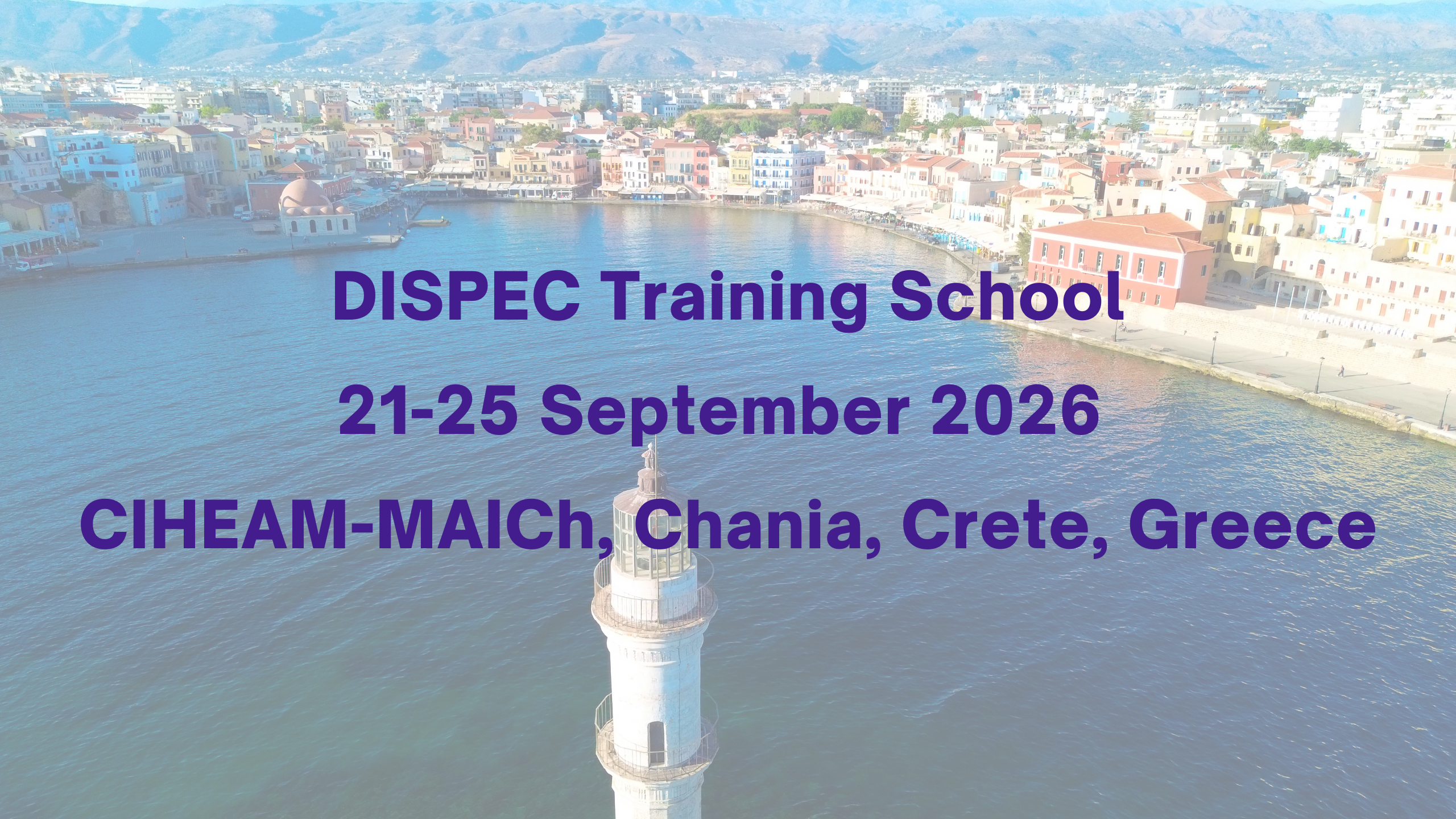
 The Training School of the "Scientific exploitation of space Data for improved Ionospheric SPECification (DISPEC)" project will be held on 21-25 September 2026 at the Conference Centre of CIHEAM-MAICh in Chania, Crete, Greece.
The DISPEC Training School is an advanced, interdisciplinary programme designed to equip early-career researchers with a solid theoretical background and practical skills in the observation, modelling, and interpretation of ionospheric variability and disturbances.
The school focuses on the physics and dynamics of the ionosphere across multiple spatial and temporal scales, with particular emphasis on ionospheric irregularities and space-weather-driven processes that are often under-represented in standard models. Through a combination of lectures, discussion-oriented sessions and hackathons, participants will be introduced to both established and emerging methodologies used in contemporary ionospheric research.
Key objectives of the Training School are to:
- provide a coherent overview of the physical processes governing the ionosphere and its coupling with the neutral atmosphere and magnetosphere;
- familiarise participants with state-of-the-art ground-based and space-based observational techniques (e.g. GNSS, ionosondes, radars, satellite missions);
- introduce advanced modelling approaches, including data-assimilative, data-driven methods, and Machine Learning algorithms, with attention to their strengths, limitations, and applicability;
- promote critical thinking on how observations, models, and theory can be combined to produce High-Level Data Products, transforming complex, heterogeneous measurements into scientifically robust and usable products for research and applications.
The school is primarily aimed at MSc students, PhD candidates, and early postdoctoral researchers in space physics, atmospheric science, geophysics, and related fields. Participants are expected to have a basic background in space or atmospheric science, but no prior specialized expertise in ionospheric modelling is required.
By the end of the Training School, participants will be better equipped to assess and apply different observational and modelling tools in their own research and to engage with international research networks and with the Space Safety European Programme.
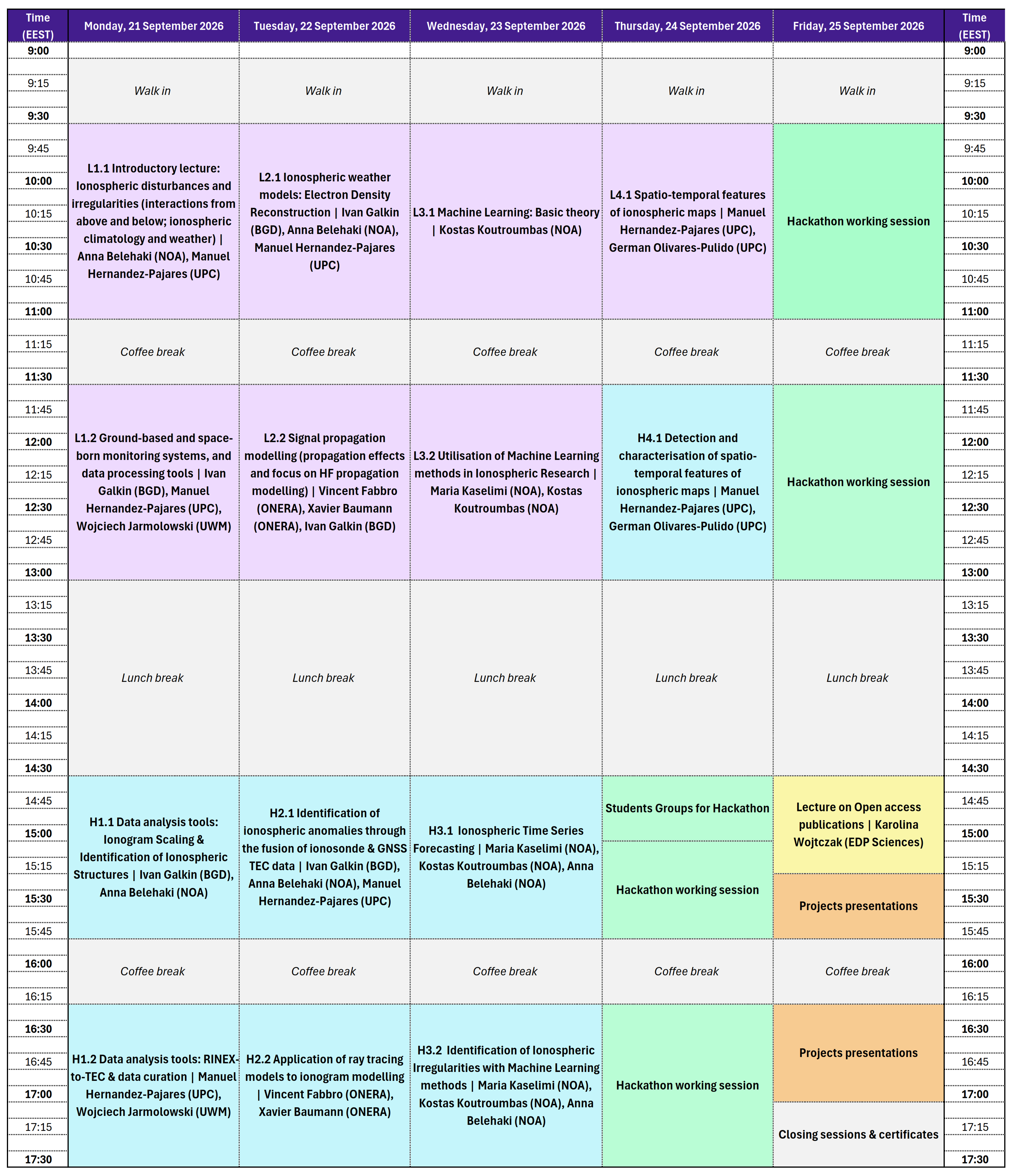
Programme
The Training School programme consists of a series of thematic lectures delivered by experts from the DISPEC consortium and invited speakers.
Event Details
When: 21-25 September 2026
Location: Conference Centre of CIHEAM-MAICh, Chania, Crete, Greece ( |
|  )
)
Format: In-person, hands-on
Speakers: 10 lectures & mentors
Working language: English
Participant Fees: Funded (The project budget covers students' accommodation and half board at MAICh). Additional travel support available via ESA Academy scholarships (see below).
ESA Academy Partial Scholarship
ESA Academy Office is pleased to sponsor up to 5 tertiary education students to attend DISPEC Training School in the frame of the ESA Academy Short Course Scholarship Programme. The partial scholarship will cover up to EUR 350 for travel costs.
Reimbursements will be made via a single bank transfer after the course, upon submission of receipts.
To be eligible for an ESA Academy Short Course Scholarship, students must fulfill the following criteria at the time of application:
- be minimum 18 years old at the time of the short course;
- be a citizen of an ESA Member State, Associate Member, or Canada;
- be enrolled as a student (Master, Doctorate) in a tertiary education academic programme (not graduating before the short course);
- not be able to attend the course through their academic programme;
- not benefit from an overlapping financial support to attend this short course, unless duly justified;
- attend the entire short course;
- agree with the conditions of the ESA Academy’s Privacy Policy.
Priority will be given to students who have less than 2 years of professional experience and have never taken part in an activity sponsored by the ESA Education Office.
The deadline for applications is 7 May 2026 at 23:59 CEST.
The decision by the Evaluation Committee will be communicated by 30 May 2026.
ESA is committed to achieving diversity and creating an inclusive environment. To this end, applications from all eligible candidates irrespective of gender, sexual orientation, ethnicity, beliefs, age, disability, social origin, or other characteristics are welcome.
Key Dates
Registration Opening: 25 February 2026
Application Closing: 7 May 2026
Acceptance Letters: 30 May 2026
Final Programme: 15 July 2026
Committees
Programme Committee: Anna Belehaki (NOA), Konstantinos Koutroumbas (NOA), Manuel Hernandez-Pajares (UPC), German Olivares-Pulido (UPC), Ivan Galkin (BGD), Wojciech Jarmolowski (UWM), Pawel Wielgosz (UWM), Vincent Fabbro (ONERA), Xavier Baumann (ONERA)
Evaluation Committee: Anna Belehaki (NOA), Pawel Wielgosz (UWM), Vincent Fabbro (ONERA)
Local Organising Committee: Angeliki Thanasou (NOA), Anna Belehaki (NOA), Themistocles Herekakis (NOA)